


By Angela Currie, Ph.D.
Pediatric Neuropsychologist; Londonderry, NH Director, NESCA
At NESCA, all neuropsychological evaluations from ages pre-k through young adult include assessment of academic skills, in addition to assessment of other domains, including intellectual, language, memory, attention, executive function, social, and emotional skills. Because learning is a primary “job” for any individual in this age range, it is important to understand how their unique profile of skills impacts their learning process as well as consider whether underlying learning issues may be impacting observed challenges with stress, inattention, etc.
Just because all evaluations include educational assessment, it does not mean that the battery of tests always looks the same. If that is so, what tests might you expect your child’s neuropsychologist to include?
First and foremost, when an evaluator is selecting tests, it is important to first consider whether learning is a specific area of concern. When caregivers and/or teachers are specifically concerned about reading, writing, and/or math, it is important to assess both the child’s achievement level as well as assess underlying reasons for any observed challenges. This can be thought of as assessing both functional (i.e., actual academic performance) and foundational (i.e., the underlying problems) skills. While understanding a student’s functional academic skills is critically important, giving insight into their day-to-day performance in school, if the foundational skills are not examined, then interventions are likely to be misinformed and ultimately less effective.
For example, a child may be referred for evaluation due to difficulties with reading, and perhaps there is a family history of dyslexia. For this child, the educational portion of the evaluation would consider four functional skill domains, including:
- Decoding – ability to sound and blend together unfamiliar words
- Sight word reading – ability to recognize whole words
- Fluency – reading efficiency, or speed
- Comprehension – understanding of written material
While information about the above functional reading skills may tell us a lot about how the child’s reading skills are presenting, the scores alone do not elucidate the underlying neurocognitive pattern that contributes to these scores. So, in addition to assessment of cognition, processing, and memory, the evaluation will also examine the following foundational skills for each domain:
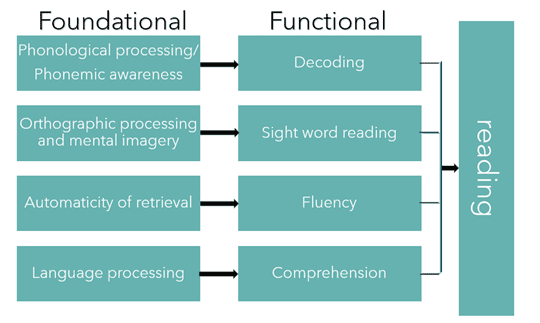
This graph demonstrates that these skills build directionally – without having the underlying ability to hear sounds in words, appreciate what words look like “in your head,” quickly access information from memory, or understand meaning within language, then individual, functional reading skills will not develop as expected, and overall reading will be behind. Similar analysis can be done for writing, such as examining skills for language expression and retrieval, mechanics, grammar, and word forms. For those with math concerns, examination of applied problem solving, calculations, and fluency as functional skills is important, but so is examination of the foundational skills of orthography, retrieval, visual-motor integration, visual processing and imagery, and quantitative reasoning.
Even for those who are referred for neuropsychological evaluation for concerns that are not directly academic, it is still critical to assess reading, writing, and math achievement and efficiency (i.e., fluency) as key skills on which they rely for their “full time job” of learning. This is also important because many individuals with ADHD, anxiety, mood challenges, or other neurodivergence often experience challenges with executive function. Executive function is a set of cognitive and regulator skills that allow for efficient, goal-oriented problem solving and task completion. This includes skills such as planning, organizing, managing time, self-monitoring work process, and controlling impulses. With this, it is very common for individuals with such challenges to experience slow academic fluency or efficiency, despite strong achievement. Academic achievement scores are thus critical for informing the appropriateness of various academic accommodations, such as extended time for tests or accessing teacher notes.
Children, teens, and young adults spend much of their time learning – both in and out of the classroom. It is for this reason that, at NESCA, full consideration of their educational profile is considered to be a critical component of any neuropsychological assessment. We aim to understand what we see – the functional skills, or achievement – but we also aim to see the foundational needs so that interventions and accommodations can truly meet the student’s needs. More information about NESCA’s approach to neuropsychological assessment can be found on our website at https://staging.nesca-newton.com/neuro_eval/.
About the Author
To book an evaluation with Dr. Currie or one of our many other expert neuropsychologists, complete NESCA’s online intake form. Indicate whether you are seeking an “evaluation” or “consultation” and your preferred clinician in the referral line.
NESCA is a pediatric neuropsychology practice and integrative treatment center with offices in Newton, Plainville, and Hingham, Massachusetts; Londonderry, New Hampshire; and staff in greater Burlington, Vermont and Brooklyn, New York, serving clients from infancy through young adulthood and their families. For more information, please email info@nesca-newton.com or call 617-658-9800.
 meaningful skills in order to reach their goals. She has spent the majority of her career working in a private school for students with ASD. She has also spent some time working in an inpatient mental health setting. Lyndsay uses occupation-based interventions and strategies to develop life skills, executive functioning, and emotional regulation. While completely her doctoral degree at MGH Institute of Health Professions, Lyndsay worked with the Boston Center for Independent Living to evaluate transition age services. She uses the results from her research to deliver services in a way that is most beneficial for clients. Specifically, she focuses on hands-on, occupation-based learning that is tailored the client’s goals and interests.
 unique pattern of strengths and weaknesses to best formulate a plan for intervention and success. With experiences providing therapy and assessments, Dr. Creedon bridges the gap between testing data and therapeutic services to develop a clear roadmap for change and deeper of understanding of individual needs.
 staff at Johns Hopkins University and trained at the University of California, Los Angeles (UCLA). She provides comprehensive neuropsychological evaluations of children, adolescents, and young adults who have learning, behavioral, and socio-emotional challenges. Her areas of expertise include Autism Spectrum Disorder and other conditions that usually co-occur with this diagnosis; Attention-Deficit/Hyperactivity Disorder; Dyslexia and other Specific Learning Disabilities; and Anxiety/Depression. She thinks that the best part of being a pediatric neuropsychologist is helping change the trajectory of children’s lives.
 from elementary school through young adulthood. In addition to direct client work, Ms. Badamo provides consultation and support to parents and families in order to help change dynamics within the household and/or support the special education processes for students struggling with executive dysfunction. She also provides expert consultation to educators, special educators and related professionals.

 extensive experience working with children and adolescents with a range of learning and social/emotional abilities. Kristen’s strengths lie in her communication and advocacy skills as well as her strengths-based approach. She is passionate about developing students’ self-awareness, goal-setting abilities, and vision through student-centered counseling, psychoeducation, social skills instruction, and executive functioning coaching. Mrs. Simon has particular interests working with children and adolescents on the Autism spectrum as well as individuals working to manage stress or anxiety-related challenges.
 research and academia for over 30 years. She is a national consultant and speaker on program design and the inclusion of children and adolescents with special needs, especially those diagnosed with Autism Spectrum Disorder (ASD). Prior to joining NESCA, Ms. Lucci was the Principal of the Partners Program/EDCO Collaborative and previously the Program Director and Director of Consultation at MGH/Aspire for 13 years, where she built child, teen and young adult programs and established the 3-Ss (self-awareness, social competency and stress management) as the programming backbone. She also served as director of the Autism Support Center. Ms. Lucci was previously an elementary classroom teacher, special educator, researcher, school psychologist, college professor and director of public schools, a private special education school and an education collaborative.

Connect with Us