

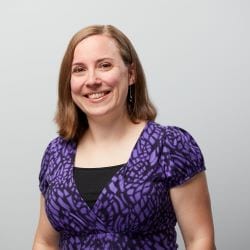
By: Alissa Talamo, Ph.D.
Pediatric Neuropsychologist
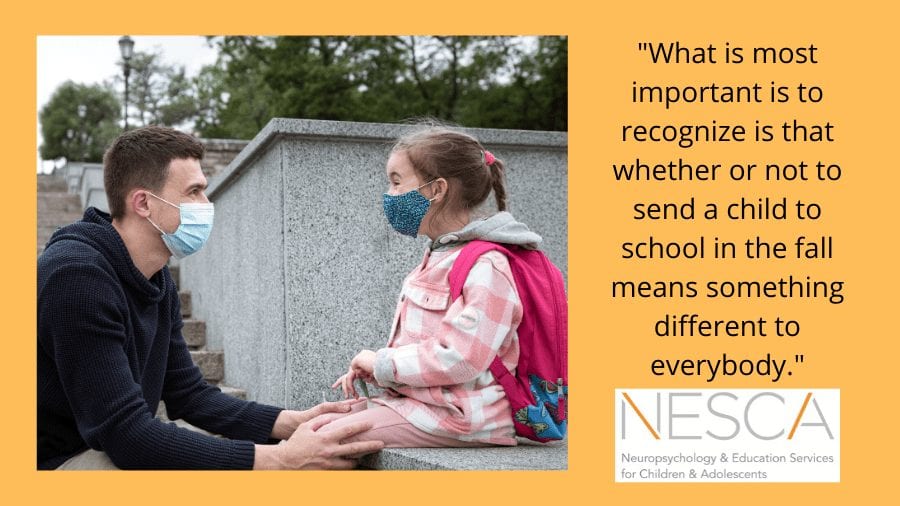
We are living in an unprecedented time. As such, parents are faced with decisions that they have never faced before. For example, families are facing the challenging decision about whether or not to send their children back to school for in-person classes in the middle of the COVID-19 pandemic. Parents have to wrestle with the idea that, on the one hand, sending children to school could increase the risk of COVID-19 among children and family members; while on the other hand, children who don’t return to in-person school may experience disruptions in their education and may miss out on the social interaction and community feeling within the school building. In addition, some families simply don’t have a choice because they need to go to work or a family member at home is immunocompromised.
What is most important is to recognize is that whether or not to send a child to school in the fall means something different to everybody. It is imperative that, as parents, you give yourself permission to feel whatever it is that you are feeling, and that you do what feels right for you and your family. It may be difficult to accept, but we have little control over much of what is happening around us right now. While it is important to acknowledge how you are feeling, it is equally important to remember that, in fact, any reactions are normal under the current circumstances.
How you respond to stress during the COVID-19 pandemic can depend on your background, your financial situation, your health and emotional background, your social support system, the community you live in and many other factors. When it comes to parenting, every day can be a challenge, and the coronavirus has made an already scary world feel even more menacing. Remember to “ignore the noise” and give yourself credit for taking care of yourself and your family.
About the Author:
With NESCA since its inception in 2007, Dr. Talamo had previously practiced for many years as a child and adolescent clinical psychologist before completing postdoctoral re-training in pediatric neuropsychology at the Children’s Evaluation Center.
After receiving her undergraduate degree from Columbia University, Dr. Talamo earned her doctorate in clinical health psychology from Ferkauf Graduate School of Psychology and the Albert Einstein College of Medicine at Yeshiva University.
She has given a number of presentations, most recently on “How to Recognize a Struggling Reader,” “Supporting Students with Working Memory Limitations,” (with Bonnie Singer, Ph.D., CCC-SLP of Architects for Learning), and “Executive Function in Elementary and Middle School Students.”
Dr. Talamo specializes in working with children and adolescents with language-based learning disabilities including dyslexia, attentional disorders, and emotional issues. She is also interested in working with highly gifted children.
Her professional memberships include MAGE (Massachusetts Association for Gifted Education), IDA (International Dyslexia Association), MABIDA (the Massachusetts division of IDA) and MNS (the Massachusetts Neuropsychological Society).
She is the mother of one teenage girl.
To book a consultation with Dr. Talamo or one of our many other expert neuropsychologists, complete NESCA’s online intake form.
Neuropsychology & Education Services for Children & Adolescents (NESCA) is a pediatric neuropsychology practice and integrative treatment center with offices in Newton, Massachusetts, Plainville, Massachusetts, and Londonderry, New Hampshire, serving clients from preschool through young adulthood and their families. For more information, please email info@nesca-newton.com or call 617-658-9800.

 complex, inter-related needs, with a particular emphasis on identifying co-occurring neurodevelopmental and psychiatric challenges. She specializes in the evaluation of developmental disabilities including autism spectrum disorder and social-emotional difficulties stemming from mood, anxiety, attachment and trauma-related diagnoses. She often assesses children who have “unique learning styles” that can underlie deficits in problem-solving, emotion regulation, social skills and self-esteem.

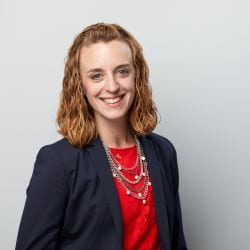 Londonderry, NH office. She specializes in the evaluation of anxious children and teens, working to tease apart the various factors lending to their stress, such as underlying learning, attentional, or emotional challenges. She particularly enjoys working with the seemingly “unmotivated” child, as well as children who have “flown under the radar” for years due to their desire to succeed.
 By:
By: 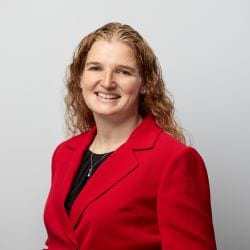
 Erin Gibbons, Ph.D.
 Professional Psychology, with a concentration in Children, Adolescents and Families (CAF). She completed post-doctoral training in pediatric neuropsychology with an emphasis on treating children with developmental, intellectual, learning and executive functioning challenges. She also has extensive training psychological (projective) testing and has conducted individual and group therapies for children of all ages. Before joining NESCA, Dr. Kulis worked in private practices, clinics, and schools, conducting comprehensive assessments on children ranging from toddlers through young adults. In addition, Dr. Kulis has had the opportunity to consult with various school systems, conducting observations of programs, and providing in-service trainings for staff. Dr. Kulis currently conducts neuropsychological and psychological (projective) assessments for school-aged children through young adulthood. She regularly participates in transition assessments (focusing on the needs of adolescents as they emerge into adulthood) and has a special interest in working with complex learners that may also struggle with emotional challenges and psychiatric conditions. In addition to administering comprehensive and data-driven evaluations, Dr. Kulis regularly conducts school-based observations and participates in school meetings to help share her findings and consultation with a student’s TEAM.
Connect with Us